Vital signs
“A vital signs screen for a teaching case. Flag anything out of range.”
| Time | BP mmHg | HR bpm | Temp °C |
|---|---|---|---|
| 06:00 | 104/66 | 104 | 38.1 |
| 07:00 | 98/62 | 112 | 38.4 |
| 08:00 | 92/58Low | 118High | 38.6Fever |
Adult reference ranges · per-value alerts
v1.3.0
Describe a tool in plain clinical words. Claude Code copies tested logic into your project, builds the screen and checks it against made-up cases. The model never does the math.
/plugin marketplace add emdmed/medical-protocol/plugin install medical-protocol@medical-protocolPaste each line in Claude Code on your laptop, in order.
NeedsClaude Code, which comes with an Anthropic subscription, and Node.js. For learning and prototyping, not patient care. Your data stays on your laptop.
> I need an ABG analyzer to study acid–base cases.
Built on your laptop Checked against made-up cases Case 1 · Match ✓ Case 2 · Match ✓ Case 3 · Match ✓ Case 4 · Match ✓ How it builds →Each module is a validated piece of clinical logic. Ask for one, or combine several on one screen: vitals feeding into sepsis scoring, ABG next to fluid balance.
“A vital signs screen for a teaching case. Flag anything out of range.”
| Time | BP mmHg | HR bpm | Temp °C |
|---|---|---|---|
| 06:00 | 104/66 | 104 | 38.1 |
| 07:00 | 98/62 | 112 | 38.4 |
| 08:00 | 92/58Low | 118High | 38.6Fever |
Adult reference ranges · per-value alerts
“An ABG analyzer for a trauma teaching case, with anion gap.”
| pH / pCO₂ / HCO₃ | 7.25 / 30 / 12 |
| Disorder | Metabolic acidosis |
| Expected pCO₂ | 24.0–28.0 mmHg |
| Compensation | InadequateCheck |
Winter's formula · Henderson–Hasselbalch check · anion gap, albumin-corrected · delta ratio
“A 24-hour fluid balance for a 70 kg practice case, oral and IV in, urine and stools out.”
| Intake | mL | Output | mL |
|---|---|---|---|
| Oral | 1500 | Diuresis | 1200 |
| IV | 500 | Stools | 240 |
| Endogenous | 315 | Insensible | 840 |
| Total | 2315 | Total | 2280 |
Net balance +35 mL.
Weight-based endogenous water and insensible losses
“Hourly glucose for a DKA practice case. Tell me if the drop is on target.”
| Hour | Glucose | Fall /h |
|---|---|---|
| 0 | 412 | – |
| 1 | 350 | 62 |
| 2 | 288 | 62.0On target |
Glucose, ketone and bicarbonate rates · resolution criteria · potassium alerts
“qSOFA first, then the full SOFA, for a sepsis case.”
| Respiratory rate | 24 /min |
| Systolic BP | 96 mmHg |
| GCS | 15 |
| qSOFA | 2 / 3Positive |
Sepsis-3 · SOFA-2, six organ systems · qSOFA (prognostic) · lactate clearance
“Classify ARDS severity from a practice gas.”
| PaO₂ | 72 mmHg |
| FiO₂ | 50 % |
| Ratio | 144Moderate ARDS |
PaO₂/FiO₂ ratio · four-tier ARDS severity
“eGFR and staging for a CKD case, with kidney failure risk.”
| Creatinine | 1.8 mg/dL |
| eGFR | 41.5 mL/min/1.73 m² |
| Category | G3bModerate–severe |
CKD-EPI 2021 · CGA staging · KFRE (4-variable) · RASi, SGLT2i, finerenone eligibility · anemia · CKD-MBD
“10-year cardiovascular risk for a practice case.”
| Total / HDL cholesterol | 213 / 50 mg/dL |
| Systolic BP | 120 mmHg |
| ASCVD 10-year risk | 5.4 %Borderline |
ASCVD pooled cohort · HEART score · CHA₂DS₂-VASc
“Classify diabetes from A1C and fasting glucose, and screen in pregnancy.”
| Diagnosis | A1C, FPG, OGTT criteria |
| Type 1 staging | Stages 1–3 |
| Type 1 vs type 2 | Clinical classification |
| Gestational | One-step and two-step screening |
ADA Standards of Care 2026 · IADPSG · Carpenter–Coustan
“A BMI calculator, metric units.”
| Weight / height | 92 kg / 1.74 m |
| BMI | 30.4Obese I |
WHO categories · metric and imperial
A trauma screen with vital signs, fluid balance and ABG.
Where you see patients, one patient or several, and whether to keep data between sessions.
The clinical calculations go into your project unchanged. Nothing is rewritten on the fly.
Before you see the screen, Claude opens it and runs test patients through it. Each result must match the built-in calculator. Ask for your own cases: Also check a 45 kg patient.
It runs in your browser. Others on the same network can open it on their tablets.
LaterChange it by asking. Add a lactate field.
Put fluid balance next to the vitals.
Claude writes a short list of test patients for each screen, opens it in a browser and enters them one by one. Each result must match the built-in calculator. When one does not, Claude fixes the screen and checks again.
Add your own cases in plain words: Also check a 45 kg, 1.60 m patient.
If you expect a different result, Claude tells you which guideline the calculation follows. It never changes the clinical logic to match.
6 of 6 checks passed. The list stays in your project and runs again after every change.
Open an app you already use, even one built without Medical Protocol. Select any part of a screen: a form, a table, an empty corner. Then pick one of three actions.
a CKD anemia tracker, and Claude builds it in place.
Nothing changes until you approve. Rebuilds and additions are prepared first. You read the result next to the screen and press Apply to keep it.
The tools it builds run on your own computer. No accounts, no cloud database, no vendor server holding your data.
One thing to know. What you type to Claude Code is sent to Anthropic, like any conversation with Claude. Describe the tool in clinical terms and use made-up cases. Never type real patient details into the chat.
The plugin installs a privacy guard. It checks every terminal command Claude Code tries to run, before it runs.
git pushcurl POSTscp, ncnpm publishnpm installnpm run devgit add, git commitcurl GET/plugin marketplace add emdmed/medical-protocol/plugin install medical-protocol@medical-protocol/medical-protocol:start and say what you need.Uses the plugin marketplace. Installs once for every project you open.
claude plugin marketplace update medical-protocolclaude plugin update medical-protocol@medical-protocolRun both in a terminal, then restart Claude Code. That gets you the newest version.
An educational project for learning and experimentation only. Do not use it, or the tools it builds, for real patient care, diagnosis or treatment. Not a medical device, not certified by any regulator, and no warranty of any kind.
Type /medical-protocol:extract in Claude Code. It opens a page on your own computer: paste a note and get the vital signs and labs, each with the words it came from. A second check re-reads the note and flags any value it does not say. Only quoted values reach the calculators.
Nothing leaves without your yes. The note is sent to the model only after you tick the box and press Extract. Use it only for notes without real patient data.
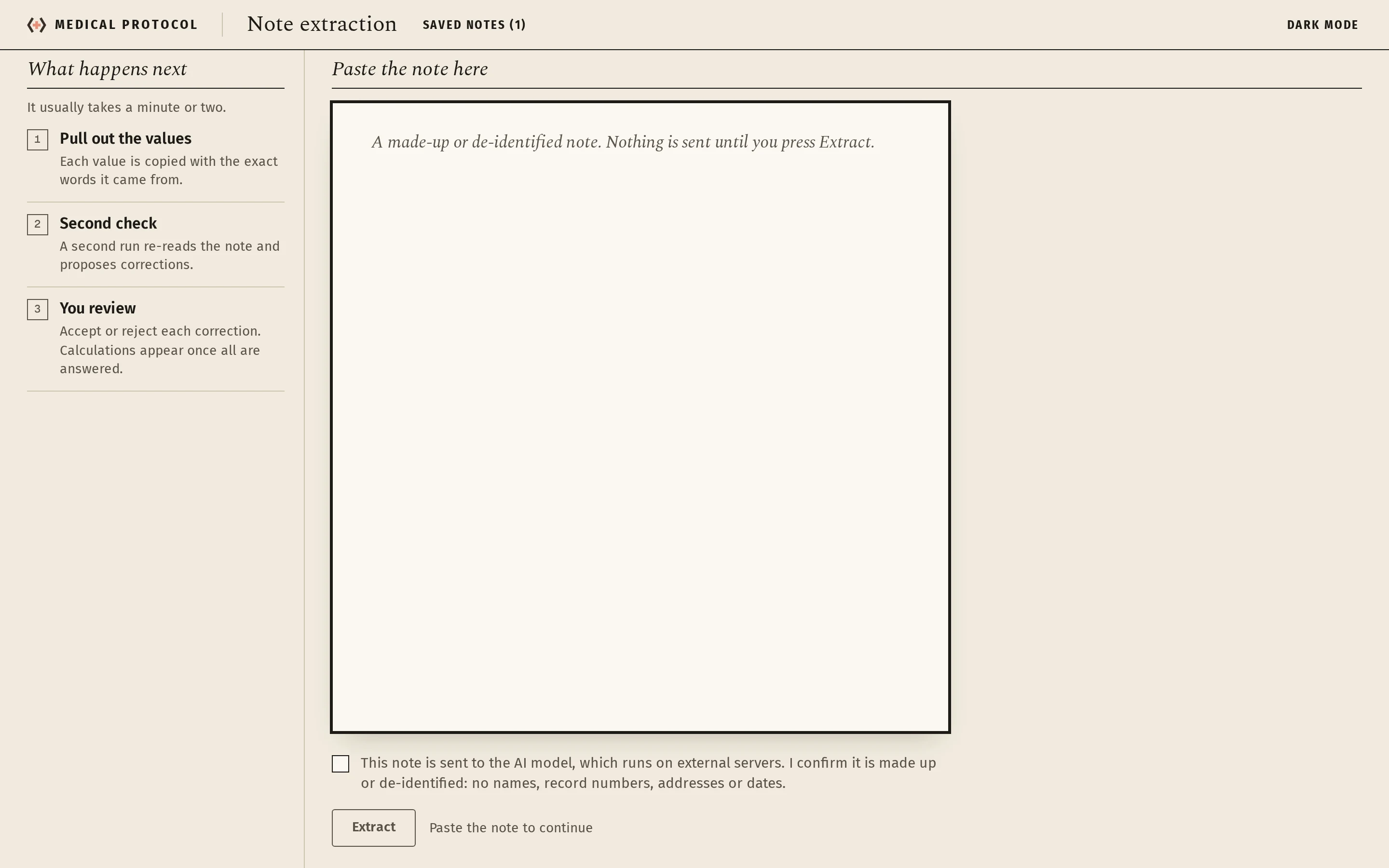
1 · Open the page. Claude Code starts it on your computer and gives you the address, usually http://localhost:7332. The left side lists the three steps that follow.
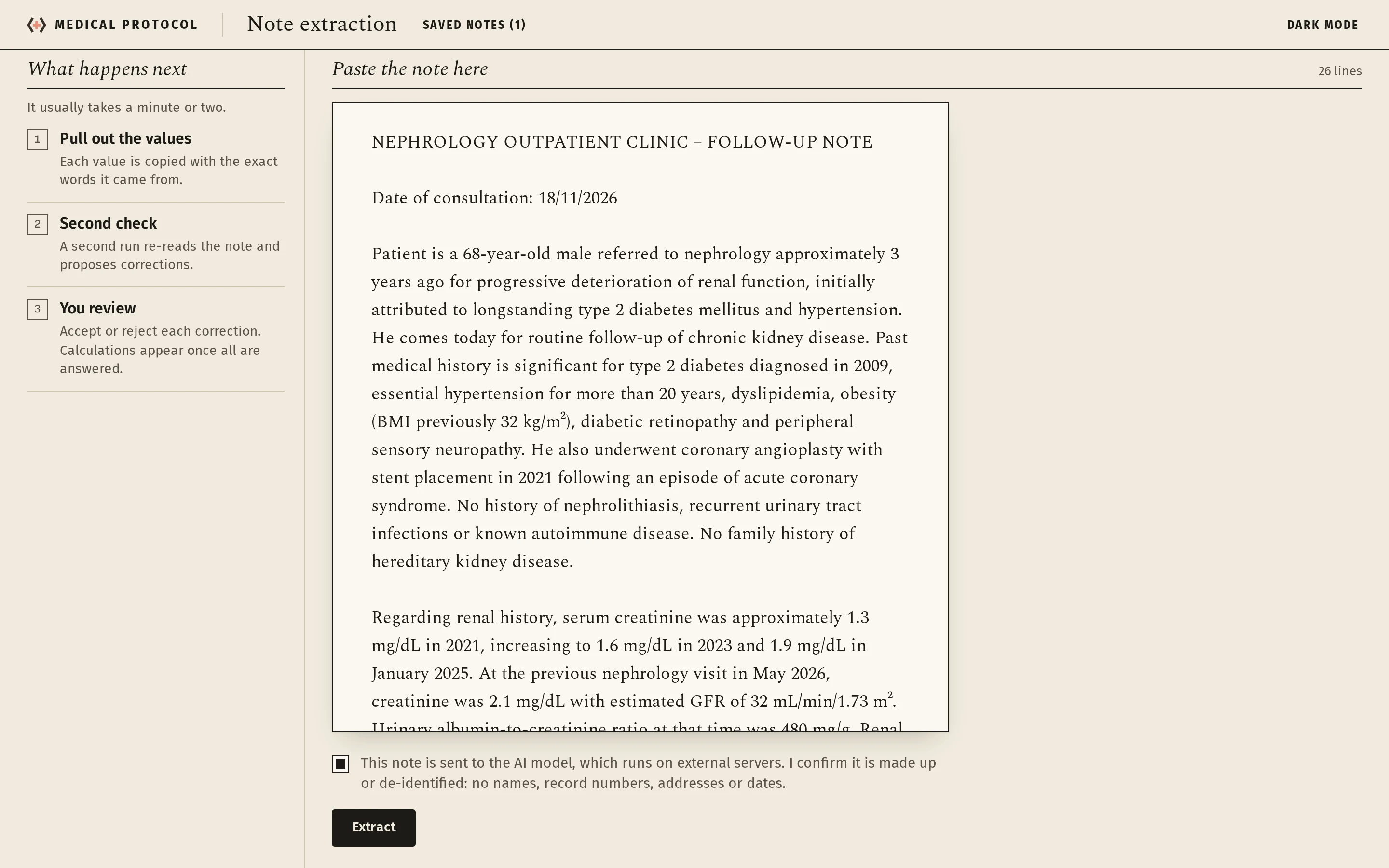
2 · Paste the note and tick the box. Use a made-up or de-identified note. Nothing is sent until you press Extract, and the button stays off until the box is ticked.
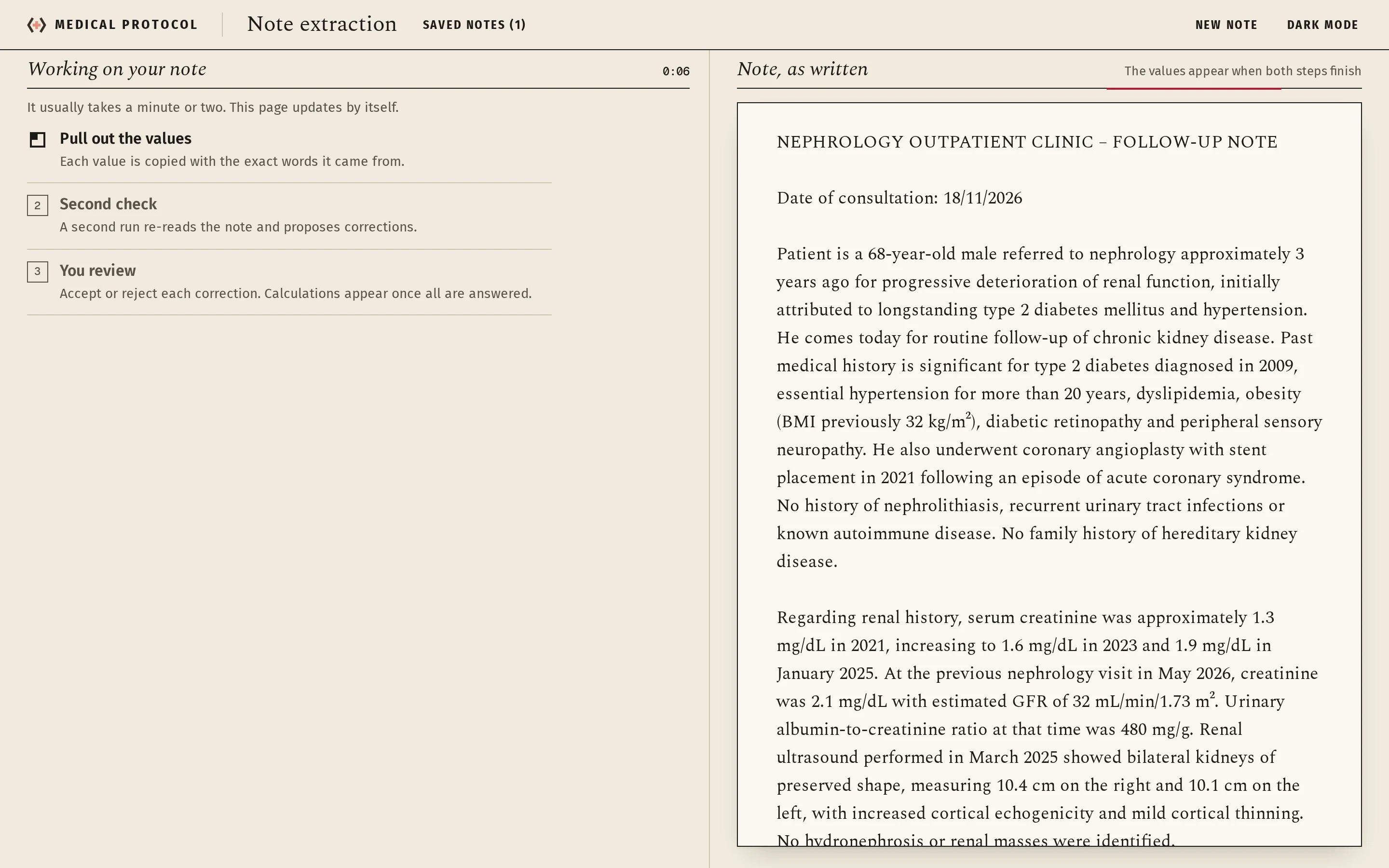
3 · The values are pulled out. Each value is copied with the exact words it came from. It usually takes a minute or two, and the page updates by itself.
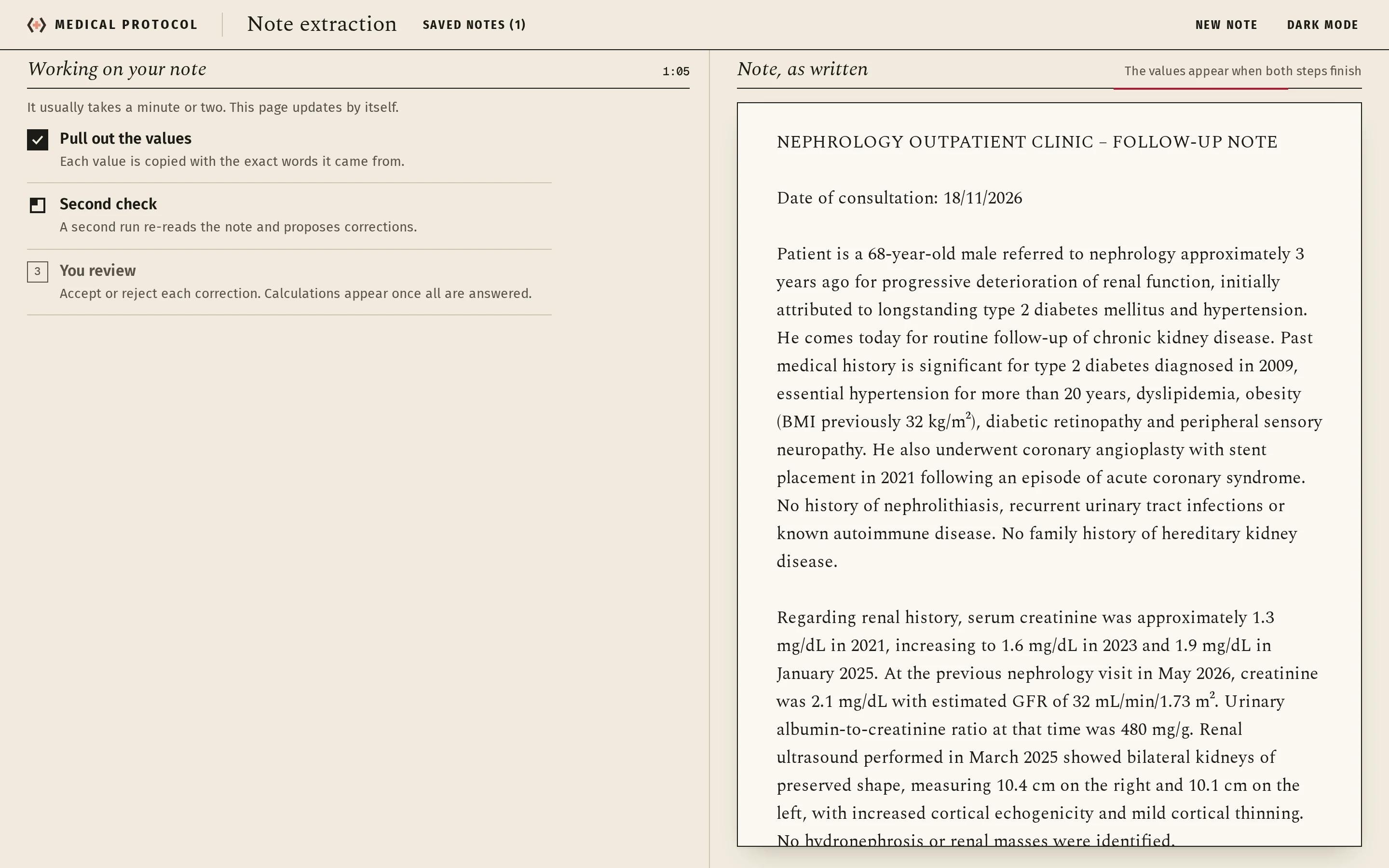
4 · A second check re-reads the note. A separate run compares the list with the note and proposes corrections where it finds a mistake.
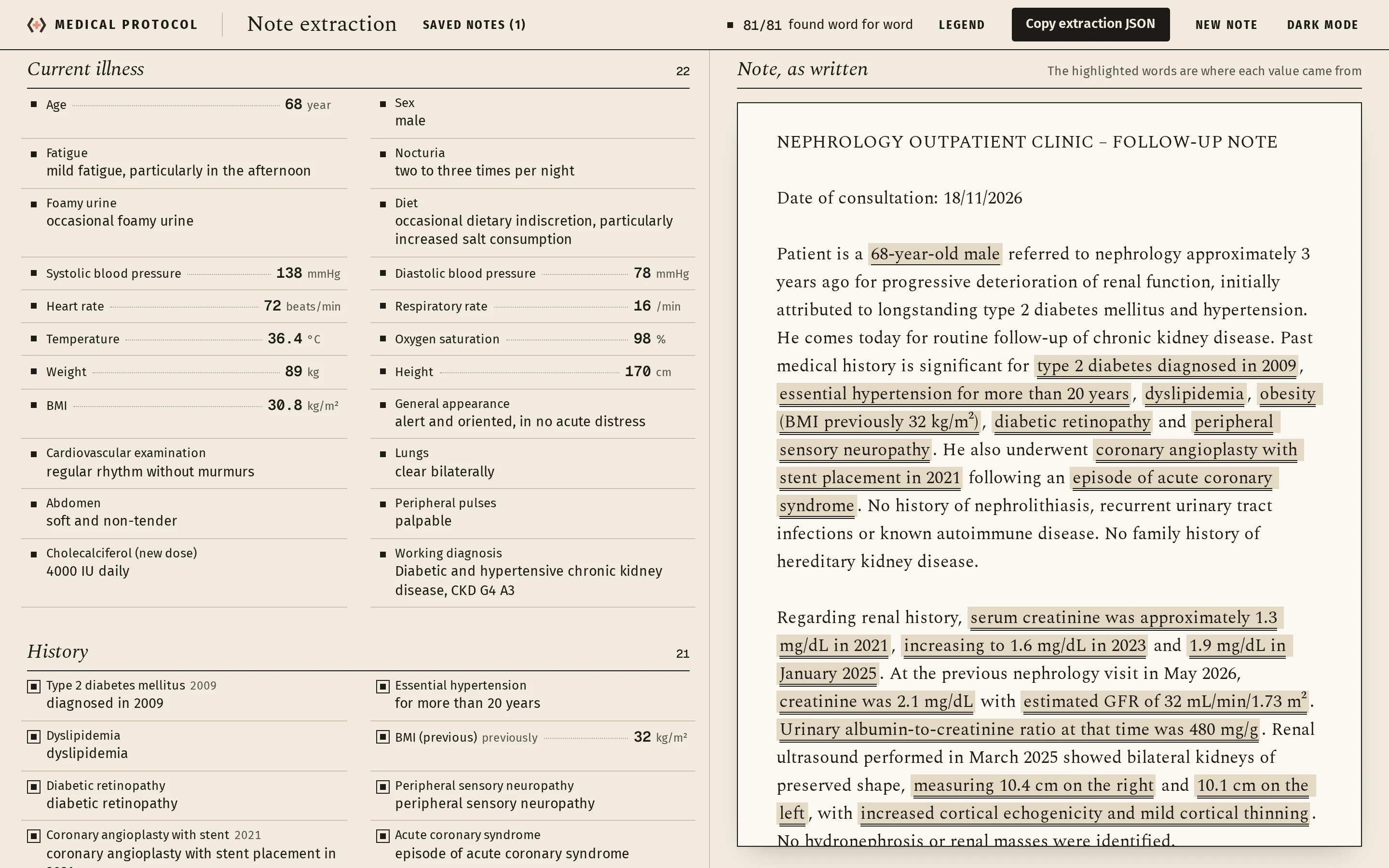
5 · You review. The values are on the left and the note on the right, with the words each value came from highlighted. The count on top says how many were found word for word. If the second check proposed corrections, they come first: accept each one or keep the original.
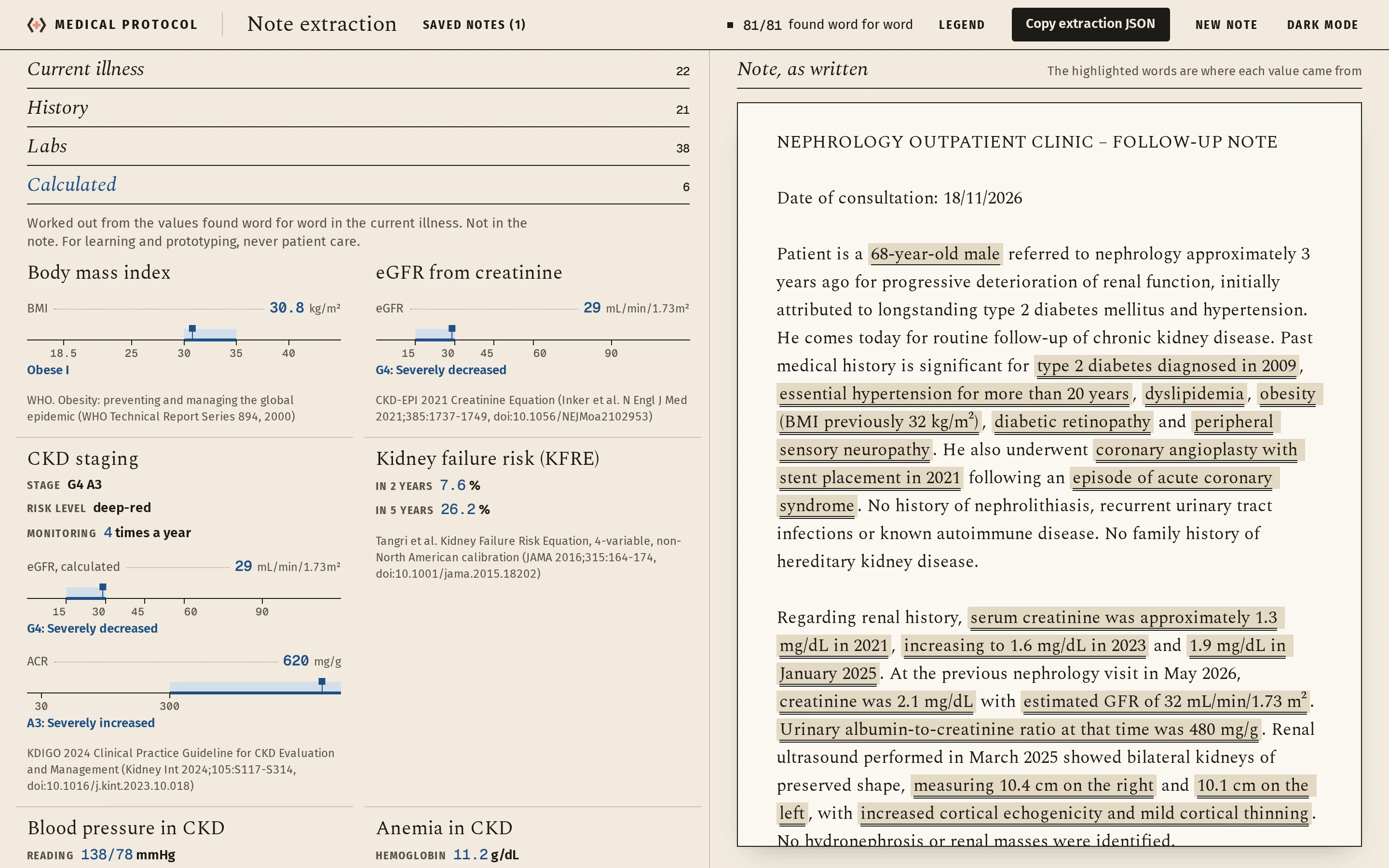
6 · The calculations appear under the values. Once every correction is answered, the page works out what the values allow, here BMI, eGFR, CKD staging and kidney failure risk, each with its source. They are marked as not in the note. Copy extraction JSON takes the result to your prototype.
One source of clinical logic. Pure TypeScript in plugin/lib/, no framework dependencies. The CLI imports it, and every generated project gets an unmodified copy at lib/medprotocol/. There are no forks to drift.
node plugin/scripts/medprotocol.cjs, shipped inside the plugin, same logic, --json on every commandqa/recipes/; a Haiku qa-runner agent drives it in the browser, expected values come from --json, fixes loop until it passesmedprotocol overlay --serve: select any element in any app, then audit, implement or add a component; diffs stay staged until approved$ medprotocol abg --ph 7.25 --pco2 30 --hco3 12 ABG Analysis ──────────── Disorder Metabolic Acidosis Compensation Inadequate compensation Interpretation Primary Metabolic Acidosis, with Inadequate compensation by Respiratory Alkalosis. Expected range 24.0–28.0 $ medprotocol pafi --pao2 72 --fio2 50 PaFi Calculator ─────────────── PaFi Ratio 144 Classification Moderate ARDS
vitalsabgwater-balancedkasepsispafickdcardiologydiabetesbmi